

-
AI Testing Maturity Assessment: Find Your Testing Level
- Level 1: Starting Your AI Testing Journey: How to Introduce AI Without Changing Your Process
- Level 2: From Pilot to Impact: How to Prove AI Value in Your CI/CD Pipeline
- Level 3: Scaling AI Test Automation: Best Practices for Expanding Coverage and Reducing Maintenance
- Level 4: AI-Augmented Testing: Achieving Coverage, Speed & Stability Across Platforms
According to the 2026 State of DevOps Report, 71% of organizations have adopted AI-powered tools for some aspect of testing, yet only 40% have achieved deep, integrated AI adoption across their platforms. While 43% of teams report comprehensive tracking of AI-related testing costs, skill gaps and measurement challenges remain key barriers to advancing maturity.
This AI Testing Maturity Assessment will help your organization accelerate your path to AI-powered test automation success by pinpointing your position on the AI Testing Maturity Curve, an essential benchmark for any software testing strategy focused on continuous delivery, intelligent automation, and quality at speed.
By taking this assessment, you will:
- Gain a clear, data-driven understanding of your current AI testing maturity
- Identify gaps in your software testing process and uncover opportunities for rapid improvement
- Receive personalized recommendations for advancing your automated testing workflows and achieving optimal test coverage
- Leverage expert guidance to accelerate your adoption of scriptless automation, multi-cloud test execution, and AI-driven test maintenance
- Empower your teams to enhance testing efficiency, stability, and ROI with proven AI testing best practices
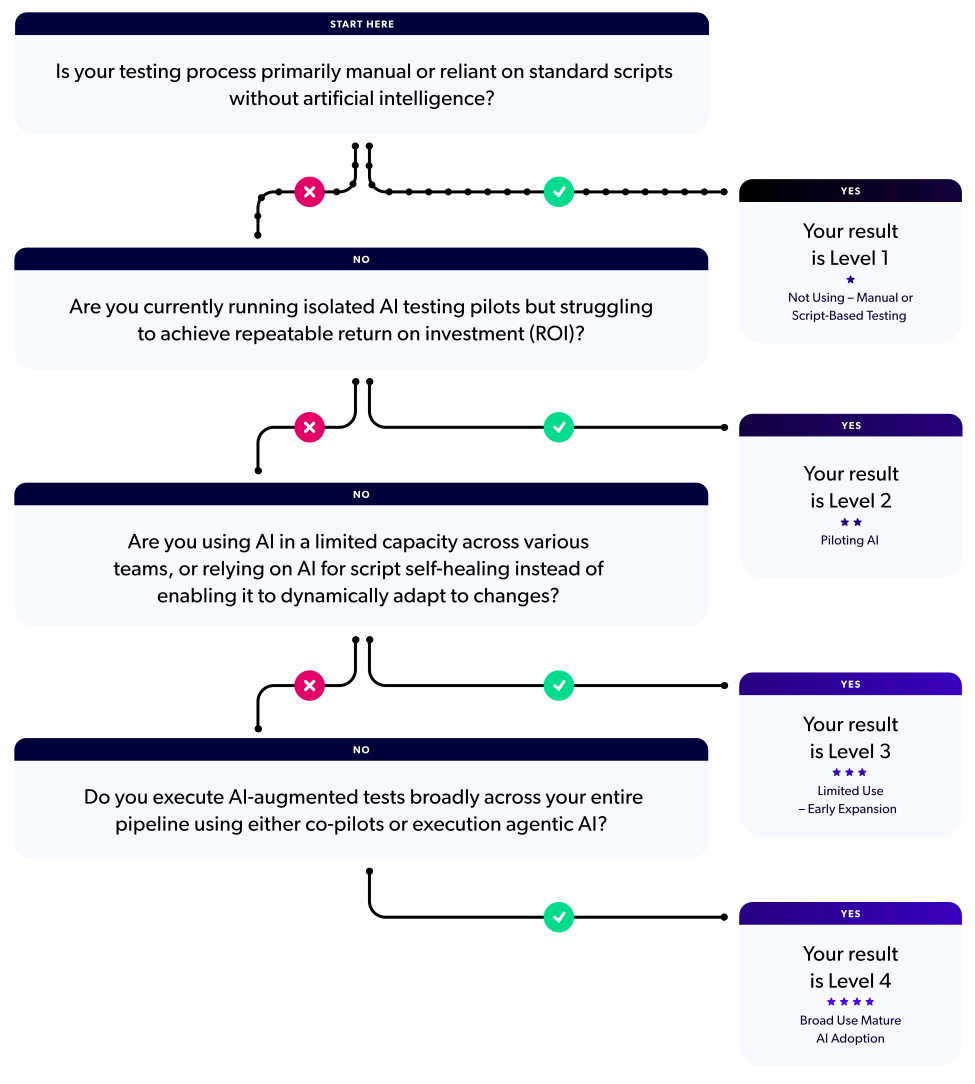
Use the flow chart below to assess your organization’s current position on the AI Testing Maturity Curve. This tool, based on established industry models for continuous delivery, helps you quickly determine your level of AI adoption in software testing. Answer the Yes/No questions in the flow chart to identify your maturity level and access detailed recommendations for accelerating your intelligent test automation with Perfecto.
Back to topStep 1: Evaluate Your AI Testing Maturity
Trace your path through the following questions to find your current maturity level.
Your Results & Action Plan
Review your maturity level below to identify your current outcomes, the benefits of advancing, and the exact steps required to progress.

Level 1: Not Using AI / Rely on Manual or Script-Based Testing
You rely on manual effort or standard automation scripts. You face a significant skills gap, high maintenance and test authoring times. You are in the majority of organizations currently building the foundation for intelligent automation.
- Current Challenge: High manual effort and slow test creation cycles that limit overall release velocity.
- Benefit of Advancing: Immediate reduction in test authoring time without requiring you to rewrite your existing frameworks.
- Your Next Step: Introduce AI-assisted capabilities gradually. Connect your existing scripts to an AI-enabled environment to analyze execution and assist with boilerplate code generation.
- Your Resource: Starting Your AI Testing Journey playbook.

Level 2: Piloting AI
You run early AI experiments but remain stuck in "pilot purgatory." You need to move from isolated tests to repeatable value to secure leadership buy-in and budget approval.
- Current Challenge: Pockets of faster test creation overshadowed by a lack of trust in the AI outputs and unclear ROI.
- Benefit of Advancing: Proven reduction in escaped defects and a documented return on investment that justifies pipeline-wide expansion.
- Your Next Step: Enhance your current automated scripts with transparent, "glass-box" AI commands. Focus on high-frequency, repetitive tests to demonstrate measurable time savings and build leadership trust.
- Your Resource: From Pilot to Impact playbook.

Level 3: Limited Use / Early Expansion
You have proven the value of AI and expanded its use across multiple teams. Your primary challenges involve maintaining consistency, training team members, and managing the maintenance burden of a growing test suite.
- Current Challenge: Improved testing speed counterbalanced by the persistent need to fix flaky locators and update broken scripts. Additionally, relying on AI self-healing of scripts often forces humans to context-switch to verify whether the self-healing appropriately handled changes in the AUT, wasting valuable time and energy of your most critical resource—your team.
- Benefit of Advancing: Drastic reduction in test maintenance hours and increased pipeline stability across all testing environments.
- Your Next Step: Implement AI specifically to target flaky tests. Use intelligent element identification to heal locators dynamically and establish standardized natural-language workflows to scale team enablement safely.
- Your Resource: Scaling AI Test Automation playbook.

Level 4: Broad Use / Mature AI Adoption
You integrate AI deeply into your automated testing pipelines. Your focus centers entirely on maximizing ROI, ensuring broad coverage, and optimizing release cycle efficiency at an enterprise scale.
- Current Challenge: High-speed, stable test execution with minimal to no manual intervention required for maintenance.
- Benefit of Advancing: Total execution AI-driven platform coverage driven by single-scenario reuse, pushing your organization toward peak continuous delivery performance.
- Execution Agentic Advantage: When changes occur in the AUT, the AI actively interacts with the application to determine if the goal of the plain-language test step can still be met. This ensures seamless adaptability and eliminates the need for human intervention.
- Your Next Step: Utilize multi-platform reuse patterns. Deploy AI to automatically adapt single test scenarios across your entire device and browser matrix, ensuring comprehensive coverage and faster time-to-market.
- Your Resource: AI-Augmented Testing playbook.